

Recent developments in European photonics demonstrate a clear transition from fundamental research towards industrial deployment and strategic technological autonomy. During the second quarter of 2026, the European photonics community presented its updated Strategic Research and Innovation Agenda (SRIA – Light Driving the Future), identifying photonics as a critical technology for Europe’s competitiveness in artificial intelligence, advanced manufacturing, semiconductor technologies, defence, healthcare, secure communications, and quantum systems. The roadmap emphasises the importance of increasing European manufacturing capacity, strengthening supply-chain resilience, and accelerating the commercial deployment of photonic innovations. [1–5]
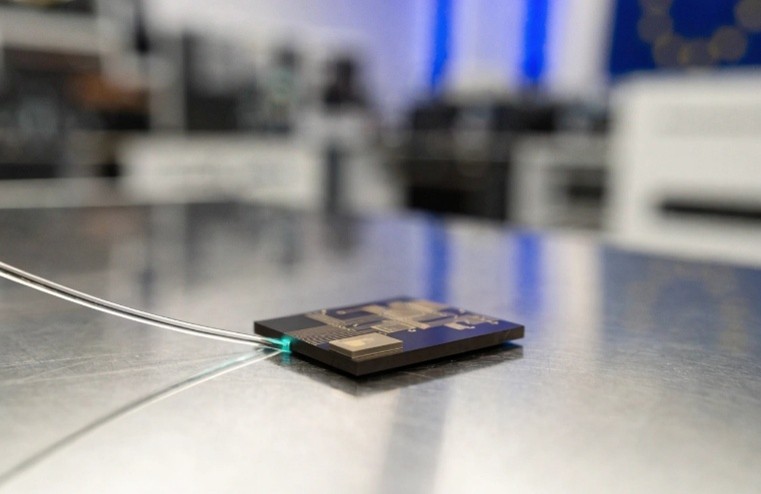
Among the most significant scientific developments is the rapid advancement of photonic integrated circuits (PICs), which combine lasers, waveguides, modulators, detectors, and electronic interfaces onto compact semiconductor platforms. Recent research focuses on scalable silicon and silicon nitride photonics, heterogeneous material integration, manufacturable fabrication processes, and design-for-test methodologies that improve reliability and industrial production. These developments are expected to play a central role in next-generation sensing, AI infrastructure, optical communications, and quantum technologies.
Artificial intelligence is increasingly integrated with photonic sensing through computational imaging, adaptive image enhancement, autonomous object recognition, and real-time edge processing. At the same time, automated optical alignment, digital metrology, and AI-assisted quality assurance are becoming standard approaches for improving manufacturing precision, repeatability, and technology readiness. Together, these developments demonstrate a broader European shift towards reliable, manufacturable, and deployable photonic systems.
At Photonics International R&D center, we continuously monitor these emerging scientific and technological developments to identify innovations with the highest potential for future research and industrial impact. Our activities focus on evaluating advanced materials, photonic integration platforms, novel device concepts, and manufacturing technologies as they mature, enabling their incorporation into our research portfolio. By aligning our work with European strategic priorities and emerging technology roadmaps, we strengthen our contribution to the European photonics ecosystem while supporting the development of reliable, scalable, and application-oriented photonic solutions.
REFRENCES
[1] Photonics21. (2026). European Technology Platform for Photonics. https://www.photonics21.org/
[2] European Commission. (n.d.). Photonics – Shaping Europe’s digital future. https://digital-strategy.ec.europa.eu/en/policies/photonics
[3] Photonics21. (2026, July). European calls & funding opportunities. https://www.photonics21.org/ppp-services/european-calls.php
[4] Science|Business. (2026, June 10). Photonics21: New photonics roadmap warns Europe cannot take its technological lead for granted. https://sciencebusiness.net/network-updates/photonics21-new-photonics-roadmap-warns-europe-cannot-take-its-technological-lead
[5] Photonics21. (2026, June 9–10). Strategic Research and Innovation Agenda (SRIA): Light Driving the Future. Presented at the Photonics Partnership Annual Meeting 2026, Brussels, Belgium. https://www.photonics21.org/ppp-services/photonics-downloads.php