
An optical concept becomes a usable product only when testing shows that it performs as intended under real operating conditions. A lens, a detector, or a coating may each meet its own specification, and the assembled system can still lose image quality once mechanical tolerances, temperature, and electronics act together. System-level validation therefore asks a different question from component testing: does the complete signal chain deliver the required performance, repeatably, in the situations where the instrument will actually be used? Shared standards make the answers comparable. EMVA 1288 describes how cameras and image sensors should be characterised, while ISO 10110-7 provides a consistent way to specify imperfections on optical surfaces [1, 2].
Validation programmes are usually organised around technology readiness. Laboratory work at TRL 4 establishes controlled performance, while TRL 5 and 6 ask whether the design survives representative interfaces, duty cycles, and environmental loads. Current practice combines physical testing with digital twins, hardware-in-the-loop evaluation, automated data capture, and statistically designed experiments, so that many configurations can be covered without repeating every measurement by hand. Systems engineering provides the framework that keeps requirements, verification activities, and configuration control connected across the life cycle [5]. The reason for this structure is simple: a result matters only if someone else can reproduce it from the same documented conditions.
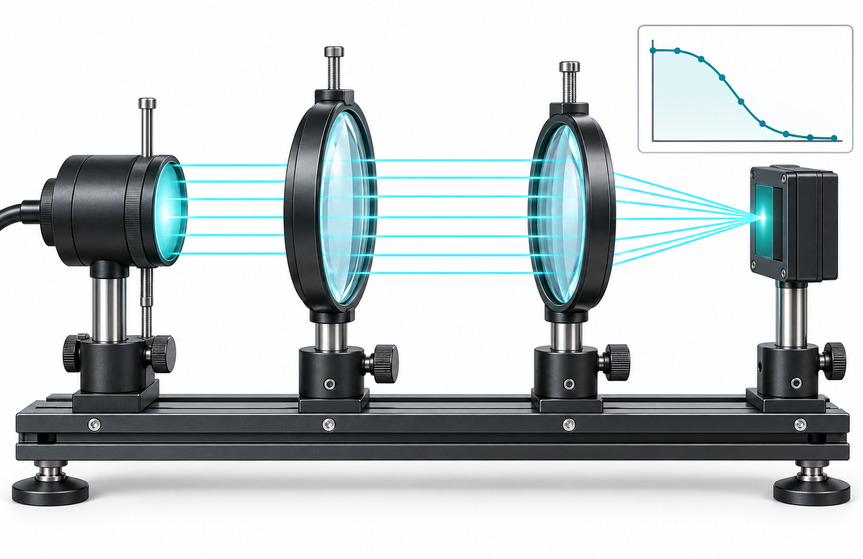
At Photonics International R&D center, each validation campaign begins with a use case, measurable requirements, interfaces, and acceptance limits. Calibrated sources, integrating spheres, collimators, and target projectors generate known radiance and geometry, while reference photodiodes, spectroradiometers, interferometers, and positioning stages keep the measurement traceable. From these stimuli we derive end-to-end metrics: spectral responsivity, limiting sensitivity, signal-to-noise ratio, modulation transfer function, distortion, field uniformity, stray light, dynamic range, latency, and thermal stability. Measurements are repeated across field angle, wavelength, focus, exposure, and temperature, so that a single best case is not mistaken for typical performance.
The main difficulty is representativeness. No laboratory can reproduce every field condition, and a small change in configuration can make two results impossible to compare. Validation must identify the dominant variables, stress them deliberately, and state the limits of each conclusion, while raw data, processing versions, calibration certificates, and environmental logs stay linked to the reported result. The Center is extending this work toward automated campaigns, digital-twin correlation, AI-assisted anomaly detection, and shared European protocols, in line with the need for stronger pilot-line and validation capacity in European photonics [6]. The goal is a verified operating envelope and an evidence chain that carries a design from research prototype to qualified photonics subsystem.
REFERENCES
[1] International Organization for Standardization. (2017). Optics and photonics Preparation of drawings for optical elements and systems Part 7: Surface imperfections (ISO Standard No. 10110-7:2017). https://www.iso.org/standard/65444.html
[2] European Machine Vision Association. (2021). EMVA Standard 1288: Standard for characterization of image sensors and cameras (Release 4.0 linear). https://www.emva.org/standards-technology/emva-1288/
[3] International Organization for Standardization. (2017). General requirements for the competence of testing and calibration laboratories (ISO/IEC Standard No. 17025:2017). https://www.iso.org/standard/66912.html
[4] Joint Committee for Guides in Metrology. (2008). Evaluation of measurement data—Guide to the expression of uncertainty in measurement (JCGM 100:2008). Bureau International des Poids et Mesures. https://www.bipm.org/documents/20126/2071204/JCGM_100_2008_E.pdf
[5] International Council on Systems Engineering. (2023). Systems engineering handbook: A guide for system life cycle processes and activities (5th ed.). Wiley. https://doi.org/10.1002/9781119814290https://www.nist.gov/news-events/news/2016/04/new-chip-based-sensor-finds-power-versatility
[6] Photonics21. (2026). Light driving the future: Photonics strategic research and innovation agenda 2028–2034. https://www.photonics21.org/download/ppp-services/photonics-downloads/Photonics_Strategic_Research_and_Innovation_Agenda_2028-2034_C1.pdf