

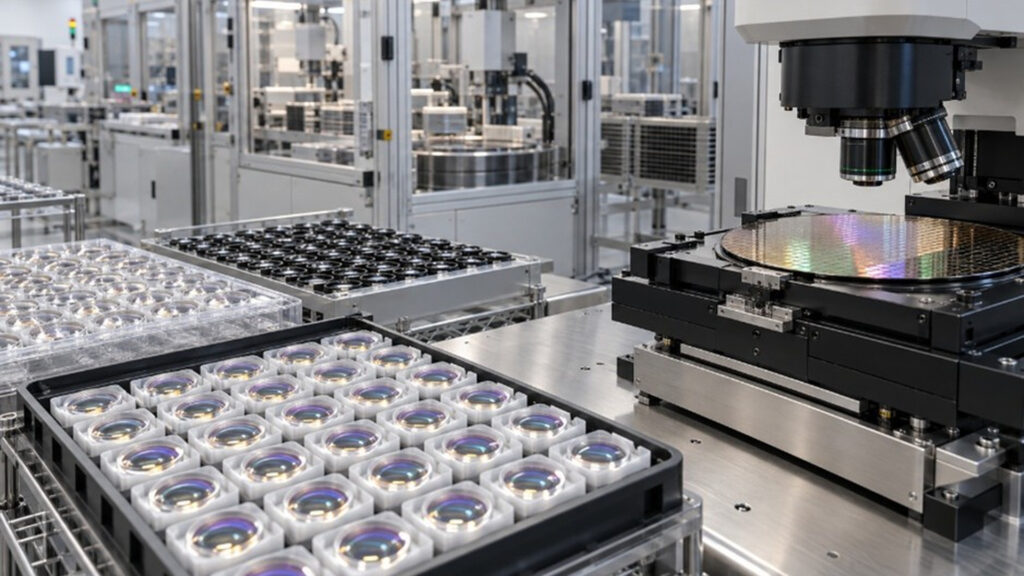
In precision photonics, a successful laboratory prototype is only the first step. A photocathode, a coated optical element, or a GaAs-based device must also be made repeatedly, with predictable performance and a manageable rate of rejected parts. Manufacturing readiness asks whether the materials, equipment, measurements, and suppliers can support this transition. Manufacturing readiness levels complement technology readiness levels by assessing manufacturing risks as a device moves towards production [1]. For photonics, this means understanding not only whether a component works, but also how reliably it can be made.
Europe is developing infrastructure to help close this gap. The PIXEurope project is establishing an open-access pilot line for photonic integrated circuits, connecting chip fabrication with packaging, testing, and reliability assessment. Its purpose is to help researchers and companies transfer new processes into industrial use and reduce the risks of scaling them [2]. The Photonics21 strategic research and innovation agenda for 2028–2034 also highlights the need for stronger European supply chains, accessible prototyping, and cost-efficient low-volume manufacturing [3]. Together, these initiatives show why manufacturing capability is becoming a research priority alongside device performance.
At Photonics International R&D center, our research perspective is measurement-driven process development. This includes defining process windows for photocathode activation and GaAs epitaxial growth, and linking measurements taken during production to the performance of the finished device. AI-driven optical inspection can support this work by identifying unusual surface features and helping engineers investigate recurring defects. Methods such as EfficientAD demonstrate that image-based anomaly detection can operate at millisecond-level latencies [4]. For our component programmes, the aim is to combine inspection results with process records and performance tests, so that quality data can guide process improvements and, once sufficient evidence is available, support yield estimates.
The longer-term goal is to make laboratory processes transferable to manufacturing partners. This requires clear procedures, traceable measurements, and validation across different batches, operators, and equipment. Small production runs can make statistical conclusions difficult, while qualification and supplier dependencies add further uncertainty. Our aim is to provide validated process parameters, inspection methods, and reliability evidence that help partners assess these risks before expanding production. This direction is consistent with Photonics21’s emphasis on industrial scale-up and supply-chain resilience [3], and with the European Defence Fund’s support for collaborative defence research and development [5]. Manufacturing readiness therefore connects scientific progress with the evidence needed for dependable production.
REFERENCES
[1] Office of the Secretary of Defense Manufacturing Technology Program. (2022). Manufacturing readiness level (MRL) deskbook (Version 2022). https://dodmrl.com/MRL_Deskbook_2022__20221001_Final.pdf
[2] European Commission. (n.d.). Advanced photonic integrated circuits pilot line for Europe (PIXEurope). CORDIS. https://cordis.europa.eu/project/id/101213727
[3] Photonics21. (2026). Light driving the future: Photonics strategic research and innovation agenda 2028–2034. https://www.photonics21.org/download/ppp-services/photonics-downloads/Photonics_Strategic_Research_and_Innovation_Agenda_2028-2034_C1.pdf
[4] Batzner, K., Heckler, L., & König, R. (2024). EfficientAD: Accurate visual anomaly detection at millisecond-level latencies. In Proceedings of the IEEE/CVF Winter Conference on Applications of Computer Vision (pp. 128–138). https://openaccess.thecvf.com/content/WACV2024/html/Batzner_EfficientAD_Accurate_Visual_Anomaly_Detection_at_Millisecond-Level_Latencies_WACV_2024_paper.html
[5] European Commission, Directorate-General for Defence Industry and Space. (2025, December 17). Commission continues to strengthen European collaborative defence research and development with additional EUR 1 billion. https://defence-industry-space.ec.europa.eu/commission-continues-strengthen-european-collaborative-defence-research-and-development-additional-2025-12-17_en