

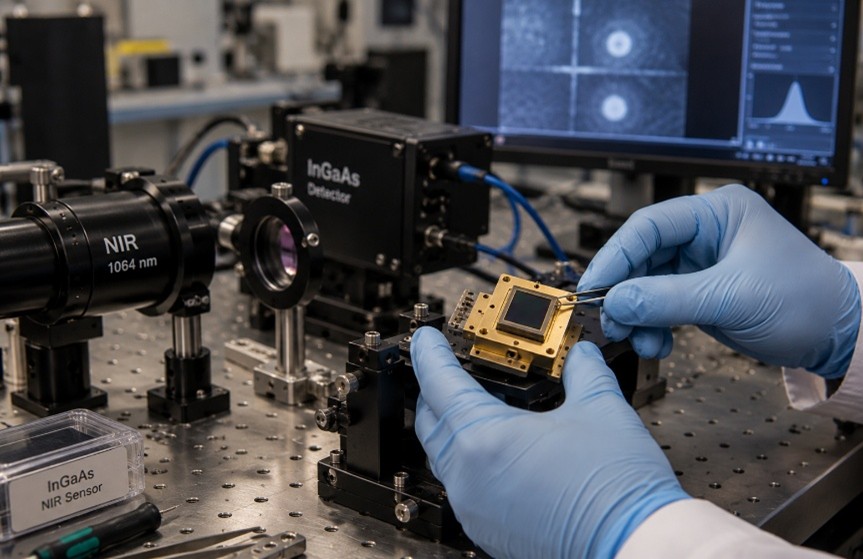
Near-infrared (NIR) photonic sensors detect light beyond human vision, bridging conventional silicon imaging and short-wave infrared (SWIR) systems. The 1060–1064 nm region is especially important for laser alignment, gated imaging, and low-light observation. Silicon response falls rapidly near 1.1 µm, whereas InGaAs cameras commonly cover about 950–1700 nm [1]. That wider band reveals laser spots, moisture contrast, semiconductor features, and nightglow that visible cameras miss. The photograph shows a NIST optical-radiation bench used to develop compact photonic measurement methods [6].
Three technology routes compete and complement one another. Vacuum image intensifiers can extend red response toward 1064 nm when photocathode composition, activation, and surface engineering improve electron emission [3]. InGaAs p-i-n photodiodes and focal-plane arrays provide direct solid-state imaging across the core SWIR band; research devices have demonstrated low-noise night vision and gated viewing [2]. InGaAs/InP single-photon avalanche diode (SPAD) arrays add precise time-of-flight measurement for low-return scenes. The European ENLIGHTEN programme is developing this route for non-line-of-sight imaging in the SWIR [4].
At Photonics International R&D center, we treat the ~1060 nm band as a complete detection problem. Our work links photocathode spectral engineering, quantum-efficiency measurement, intensifier gain statistics, detector dark noise, and calibrated scene modelling. The same test scenes are measured with intensified and InGaAs channels so that sensitivity, resolution, dynamic range, latency, and probability of detection can be compared under identical conditions. This traceable approach turns a promising material result into a credible sensor-architecture recommendation for laboratory, industrial, and defence applications.
The remaining challenges are practical as much as physical: thermal dark current, pixel non-uniformity, afterpulsing in avalanche devices, optical losses, and the cost and supply depth of InGaAs epitaxy and SWIR optics. Progress therefore depends on co-designing the detector, readout electronics, illumination, calibration, and classification software. We expect NIR-optimised channels to become part of multi-band sensor suites in which laser-event detection, intensified imaging, SWIR ranging, and AI-assisted scene interpretation share a common, validated data chain.
REFERENCES
[1] Hamamatsu Photonics K.K. (n.d.). InGaAs cameras. https://www.hamamatsu.com/us/en/product/cameras/ingaas-cameras.html
[2] Rutz, F., Aidam, R., Bächle, A., Heußen, H., Bronner, W., Rehm, R., Benecke, M., Brunner, S., Göhler, B., Lutzmann, P., & Sieck, A. (2018). InGaAs-based SWIR photodetectors for night vision and gated viewing. In Electro-Optical and Infrared Systems: Technology and Applications XV (Vol. 10795). SPIE. https://doi.org/10.1117/12.2325665
[3] Wang, Z., Zhang, Y., Li, S., Tang, S., Zhang, J., Qian, Y., Shi, F., Jiao, G., Cheng, H., & Zeng, Y. (2023). Enhancement of near-infrared response of InGaAs photocathode through interaction of 1064 nm light with activated surface. Applied Surface Science, 619, 156760. https://doi.org/10.1016/j.apsusc.2023.156760
[4] Politecnico di Milano, DEIB. (n.d.). ENLIGHTEN: European Non-Line-of-Sight Optical Imaging. https://www.deib.polimi.it/eng/european-projects/details/488
[5] National Institute of Standards and Technology. (2016). New chip-based sensor finds power in versatility [Photograph by J. L. Lee]. https://www.nist.gov/news-events/news/2016/04/new-chip-based-sensor-finds-power-versatility
[6] National Institute of Standards and Technology. (n.d.). Radiation: NIST on a Chip [Photograph]. https://www.nist.gov/noac/technology/radiation