

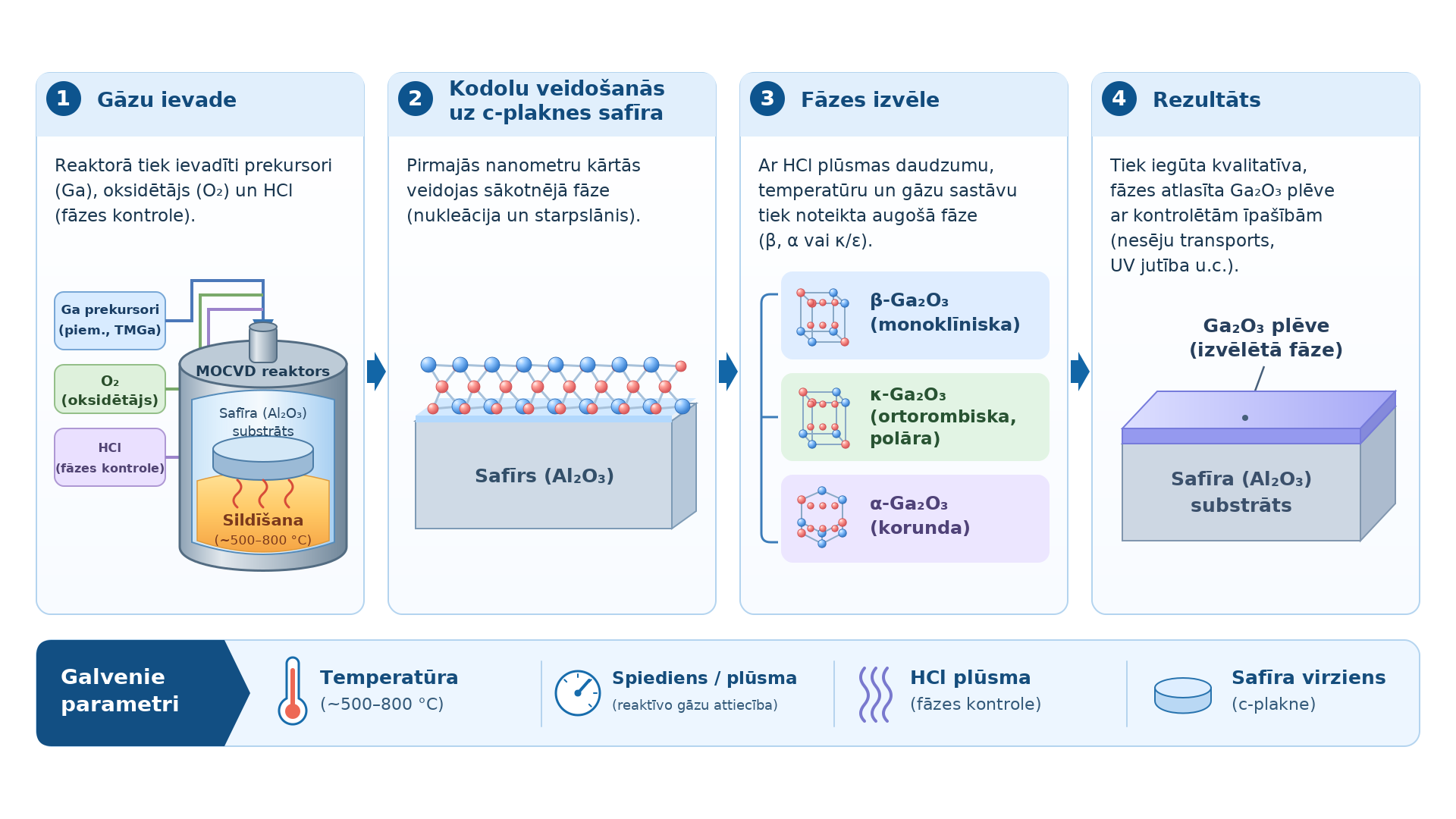
Gallium oxide (Ga₂O₃) can form several crystal structures, or polymorphs, including β, α and κ (often associated with ε). Their structural differences influence the electronic bandgap, defects and potential use in ultraviolet optoelectronics. In epitaxial growth on sapphire, the earliest stages of film formation are especially important because they influence which crystal phase develops [1, 2].
The stable β-phase has a monoclinic structure and a bandgap near 4.8 eV. The metastable α-phase has a corundum structure similar to sapphire and a wider bandgap of approximately 5.3 eV. The κ-phase is orthorhombic and polar; films historically identified as ε-Ga₂O₃ can contain nanoscale κ-like rotational domains. These differences matter because lattice mismatch and domain boundaries can create defects that influence light absorption and carrier transport [1, 2, 4].
In metal-organic chemical vapour deposition (MOCVD), gallium-containing precursor gases and an oxidant reach a heated sapphire substrate. Chemical reactions near the surface lead to the formation of a thin crystalline Ga₂O₃ film. The film structure depends on the substrate, temperature, gas composition and conditions during the first stages of nucleation. In a reported MOCVD study, varying HCl flow enabled β-, ε/κ-related and α-phase growth on c-plane sapphire under the investigated conditions [3].
Phase engineering aims to obtain a targeted crystal structure while reducing rotational domains and unwanted phase inclusions. Research has explored sapphire surface orientation, nucleation behaviour and epitaxial stabilization of α-Ga₂O₃. More advanced structural methods, including X-ray diffraction and transmission electron microscopy, are essential for distinguishing phases that may appear similar in conventional measurements [1, 5].
At the Photonics International R&D center, the proposed research perspective links structural phase control to photocathode function. The important question is not only which phase grows, but which defects reach the photoemitting surface. Near-surface phase inclusions and domain boundaries may influence how UV-generated electrons move and escape [1, 4]. Crystal-quality measurements such as X-ray diffraction, electron microscopy and Raman spectroscopy can therefore be compared with optical absorption, photoluminescence and photoemission quantum efficiency [1, 5].
Two promising directions are α-(AlₓGa₁₋ₓ)₂O₃ alloys for shifting the short-wavelength response [6] and κ-Ga₂O₃ layers for exploring whether built-in polarization improves electron transport toward the surface [1, 4]. These are research questions rather than established photocathode performance gains. Important questions concern the stability of metastable phases during later thermal processing, the effect of domain boundaries on charge transport, and whether polar κ-Ga₂O₃ can offer useful device advantages. Improved links between growth conditions, crystal structure and measured optoelectronic performance could help select the most appropriate gallium oxide phase for future UV technologies [1, 2].
REFERENCES
[1] Cora, I., Mezzadri, F., Boschi, F., Bosi, M., Čaplovičová, M., Calestani, G., Dódony, I., Pécz, B., & Fornari, R. (2017). The real structure of ε-Ga₂O₃ and its relation to κ-phase. CrystEngComm, 19, 1509–1516. https://doi.org/10.1039/C7CE00123A
[2] Galazka, Z. (2018). β-Ga₂O₃ for wide-bandgap electronics and optoelectronics. Semiconductor Science and Technology, 33(11), 113001. https://doi.org/10.1088/1361-6641/aadf78
[3] Sun, H., Li, K.-H., Torres Castanedo, C. G., Okur, S., Tompa, G. S., Salagaj, T., Lopatin, S., Genovese, A., & Li, X. (2018). HCl flow-induced phase change of α-, β-, and ε-Ga₂O₃ films grown by MOCVD. Crystal Growth & Design, 18(4), 2370–2376. https://doi.org/10.1021/acs.cgd.7b01791
[4] Mezzadri, F., Calestani, G., Boschi, F., Delmonte, D., Bosi, M., & Fornari, R. (2016). Crystal structure and ferroelectric properties of ε-Ga₂O₃ films grown on (0001)-sapphire. Inorganic Chemistry, 55(22), 12079–12084. https://doi.org/10.1021/acs.inorgchem.6b02244
[5] Schewski, R., Wagner, G., Baldini, M., Gogova, D., Galazka, Z., Schulz, T., Remmele, T., Markurt, T., von Wenckstern, H., Grundmann, M., Bierwagen, O., Vogt, P., & Albrecht, M. (2015). Epitaxial stabilization of pseudomorphic α-Ga₂O₃ on sapphire (0001). Applied Physics Express, 8(1), 011101. https://doi.org/10.7567/APEX.8.011101
[6] Ito, H., Kaneko, K., & Fujita, S. (2012). Growth and band gap control of corundum-structured α-(AlGa)₂O₃ thin films on sapphire by spray-assisted mist chemical vapor deposition. Japanese Journal of Applied Physics, 51(10R), 100207. https://doi.org/10.1143/JJAP.51.100207