

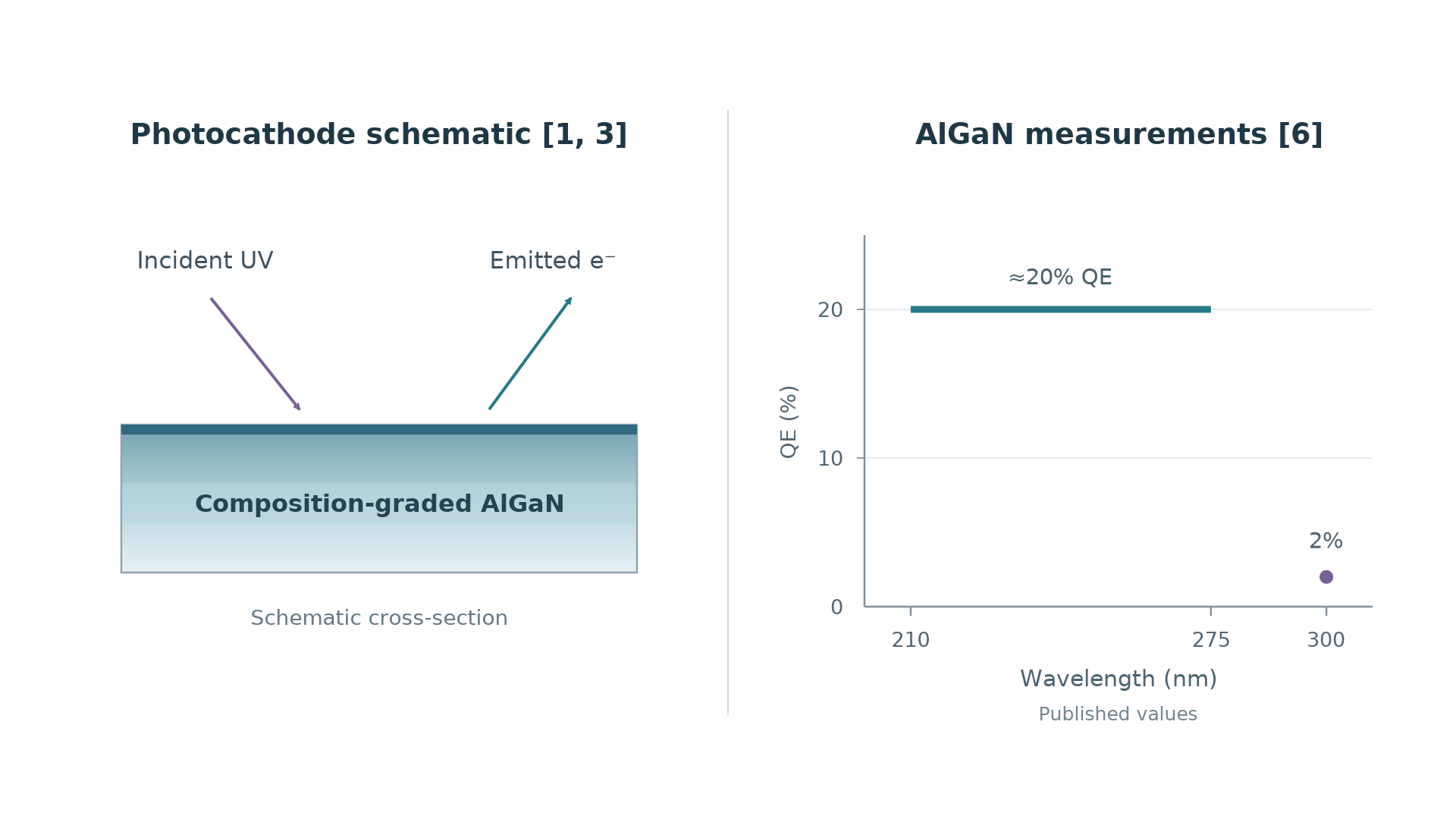
An aluminium gallium nitride (AlGaN) photocathode converts ultraviolet light into electrons that escape into a vacuum. Raising the aluminium content shifts the response towards shorter wavelengths, but it also makes it harder for magnesium dopants to supply mobile holes. Changing the aluminium content gradually through the layer offers another way to supply holes. The crystal’s built-in polarisation varies with composition, and with the right grading direction the resulting fixed charge can attract mobile holes. The emitting surface still matters. Its composition can affect how caesium adsorbs and how readily electrons escape [1, 2].
Experiments show how grading can help at different stages of detection. One AlGaN photocathode study found that a sample with varying aluminium content absorbed about half as much light as the uniform sample but had about 29% higher quantum efficiency. The authors attributed the improvement to a stronger internal field that helped photoelectrons reach the emitting surface [3]. A separate solar-blind AlGaN p-i-n photodiode with a graded p-contact reached 92% external quantum efficiency at 289 nm without an applied voltage. That result measures charge collected inside a photodiode [4].
At Photonics International R&D center, we approach the photocathode as a stack in which each layer has a role. An aluminium nitride (AlN) template supports crystal growth. A graded AlGaN absorber supplies holes and can help move photoelectrons towards the surface. A thin, heavily doped surface layer can help establish the band bending needed for emission after caesium activation. Published work shows that face-to-face annealing improves the crystal quality of sputtered AlN on sapphire [5]. We aim to compare uniform, graded and hybrid structures under the same cleaning and activation conditions, using transport simulations to interpret the measurements.
The longer-term goal is to increase UV-C sensitivity while preserving a sharp spectral cut-off and stable emission. Published AlGaN photocathode measurements show about 20% quantum efficiency across 210–275 nm, falling to 2% at 300 nm [6]. For graded structures, open questions include how strain relaxation changes the polarisation charge and how surface cleaning and activation affect electron escape. Measuring spectral response, response time, dark emission and operating lifetime on the same samples would show whether gains in sensitivity come with trade-offs in selectivity or stability. Recent experiments identify dislocation density as a major factor in the conductivity of graded p-AlGaN layers [7]. Models link photocathode response time to layer thickness and carrier transport [8] and use machine learning to estimate reflectance in AlGaN nanoarray photoemission simulations [9].
REFERENCES
[1] Simon, J., Protasenko, V., Lian, C., Xing, H., & Jena, D. (2010). Polarization-induced hole doping in wide-band-gap uniaxial semiconductor heterostructures. Science, 327(5961), 60–64. https://doi.org/10.1126/science.1183226
[2] Hao, G., Chang, B., Shi, F., Zhang, J., Zhang, Y., Chen, X., & Jin, M. (2014). Influence of Al fraction on photoemission performance of AlGaN photocathode. Applied Optics, 53(17), 3637–3641. https://doi.org/10.1364/AO.53.003637[3] Hao, G., Shi, F., Cheng, H., Ren, B., & Chang, B. (2015). Photoemission performance of thin graded structure AlGaN photocathode. Applied Optics, 54(10), 2572–2576. https://doi.org/10.1364/AO.54.002572
[4] Kalra, A., Rathkanthiwar, S., Muralidharan, R., Raghavan, S., & Nath, D. N. (2019). Polarization-graded AlGaN solar-blind p-i-n detector with 92% zero-bias external quantum efficiency. IEEE Photonics Technology Letters, 31(15), 1237–1240. https://doi.org/10.1109/LPT.2019.2923147
[5] Miyake, H., Lin, C.-H., Tokoro, K., & Hiramatsu, K. (2016). Preparation of high-quality AlN on sapphire by high-temperature face-to-face annealing. Journal of Crystal Growth, 456, 155–159. https://doi.org/10.1016/j.jcrysgro.2016.08.028
[6] Tang, G., Yan, F., Chen, X., & Luo, W. (2018). High-quantum-efficiency ultraviolet solar-blind AlGaN photocathode detector with a sharp spectral sensitivity threshold at 300 nm. Applied Optics, 57(27), 8060–8064. https://doi.org/10.1364/AO.57.008060
[7] Majchrzak, D., Tran, L. M., Babij, M., Serafińczuk, J., Pawlaczyk, Ł., Gorlanta, S., Opołczyńska, K., Kudrawiec, R., Hommel, D., & Piskorska-Hommel, E. (2024). Dislocation density as a factor compensating the polarization doping effect in graded p-AlGaN contact layers. Journal of Alloys and Compounds, 985, Article 174034. https://doi.org/10.1016/j.jallcom.2024.174034
[8] Du, J., Li, X., Jia, T., Qiu, H., Li, Y., Pu, R., Zhang, Q., Cheng, H., Guo, X., Qiao, J., & He, H. (2024). The time response of a uniformly doped transmission-mode NEA AlGaN photocathode applied to a solar-blind ultraviolet detecting system. Photonics, 11(10), Article 986. https://doi.org/10.3390/photonics11100986
[9] Wu, X., Dai, Y., Sheng, M., Zhang, Z., Diao, Y., & Xia, S. (2026). Modeling of photoemission characteristics for AlGaN nanoarrays photocathode accelerated by machine learning: From aspects of optical properties. Journal of Physics: Condensed Matter, 38(6), Article 065301. https://doi.org/10.1088/1361-648X/ae4085