

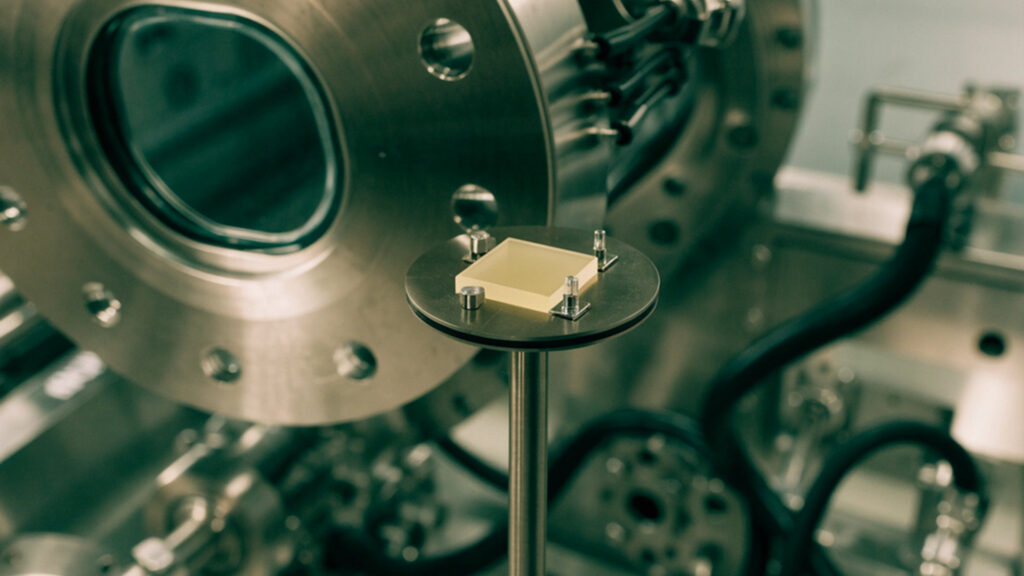
A photocathode converts light into electrons that escape from a solid into vacuum. Beta gallium oxide (β-Ga₂O₃) absorbs deep-ultraviolet light, making it attractive for solar-blind detectors. The difficulty is creating a p-type absorber, in which mobile holes carry charge. Two questions therefore govern the design of a β-Ga₂O₃ photocathode: can electrons escape its surface, and which wavelengths will actually trigger emission?
Why acceptors struggle to supply mobile holes
An acceptor can capture an electron from the valence band, leaving a hole behind. Calculations showed that the acceptors examined, including magnesium and nitrogen, have levels more than 1.3 eV above the valence-band edge [1]. At room temperature, few such acceptors can acquire an electron from that band. Even when a hole forms, nearby atoms can relax around it and localise it on an oxygen site. The trapped hole and its lattice distortion form a small polaron [2]. Both effects make sustained hole conduction difficult.
How the surface can assist electron escape
The crystal surface offers a second way to influence emission. Researchers modelled caesium and oxygen layers on the (100) face and found that the atomic termination affects the work function, the energy needed to remove an electron from the Fermi level [3]. An activation layer can shift the vacuum level through a surface dipole. Establishing negative electron affinity requires a further comparison: the vacuum level must lie below the relevant conduction-band edge at the surface.
What the emitted electrons reveal
Researchers measured emission from an iron-doped (010) crystal at 300 K [4]. For incident wavelengths of 282–354 nm, they resolved a component with a mean transverse energy of 6 meV alongside a stronger, broader component. Transverse energy describes the electrons’ sideways motion as they leave the surface. The authors linked the narrow component to excitation from iron-related states. For a solar-blind detector, emission in this wavelength range makes the spectral response of the finished cathode especially important.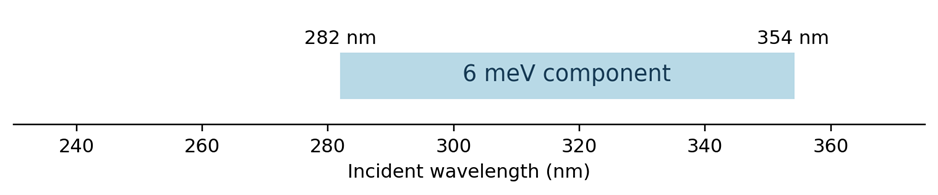 Figure 2. Shading marks the wavelength interval over which the low-transverse-energy component was observed [4]. The band indicates its reported range, not its intensity.
Research priorities for a solar-blind photocathode
A useful comparison would pair measurements of the same surface before and after activation. Photoelectron spectroscopy can track shifts in work function and band position. Measuring quantum efficiency (the number of emitted electrons per incident photon) across the ultraviolet spectrum would then show whether easier escape improves deep-UV sensitivity or also increases the response at longer wavelengths. Repeating the scan at different light intensities would help identify charging in a poorly conducting film.
At the Photonics International R&D center, we see the absence of p-type conduction in β-Ga₂O₃ not as a dead end but as a design constraint that calls for a different kind of photocathode. Our research focuses on three questions: where the Fermi level is pinned in compensated films, how much effective electron-affinity reduction caesium and caesium–oxygen layers can deliver on different crystal faces, and how semi-insulating films can avoid charging under illumination.
We investigate these questions with X-ray and ultraviolet photoelectron spectroscopy before and after activation, with work-function measurements and with photoemission tests on very thin absorbers placed on conductive interlayers. We pay particular attention to the asymmetry created by self-trapped holes: photogenerated holes are almost immobile, which may favour electron escape but can also build up positive space charge near the surface. By comparing Fe-, Mg- and N-related doping under identical conditions, we aim to establish whether a dipole-dominated Ga₂O₃ photocathode is a realistic alternative to AlGaN.
REFERENCES
[1] Lyons, J. L. (2018). A survey of acceptor dopants for β-Ga₂O₃. Semiconductor Science and Technology, 33(5), Article 05LT02. https://doi.org/10.1088/1361-6641/aaba98
[2] Varley, J. B., Janotti, A., Franchini, C., & Van de Walle, C. G. (2012). Role of self-trapping in luminescence and p-type conductivity of wide-band-gap oxides. Physical Review B, 85(8), Article 081109(R). https://doi.org/10.1103/PhysRevB.85.081109
[3] Zhang, C., Fu, X., & Wang, H. (2025). Optimization of β-Ga₂O₃ photocathode performance based on first-principles calculations. Computational Materials Science, 250, Article 113700. https://doi.org/10.1016/j.commatsci.2025.113700
[4] Angeloni, L. A., Shan, I.-J., Leach, J. H., & Schroeder, W. A. (2026). Intrinsic emittance properties of an Fe-doped β-Ga₂O₃(010) photocathode: Ultracold electron emission at 300 K and the polaron self-energy. Journal of Applied Physics, 139(9), Article 095706. https://doi.org/10.1063/5.0309595